The Best Serum for Fine Lines Over 35 Years
Fine lines becoming more noticeable after 35? You may see tiny lines around your eyes, creases across your forehead, or makeup settling into areas that used to look smooth. Sometimes your skin also looks less plump, especially after a night of poor sleep or when your complexion feels dry.
The good news is that you don’t need an eight-step anti-aging routine—or eight different serums—to care for your skin.
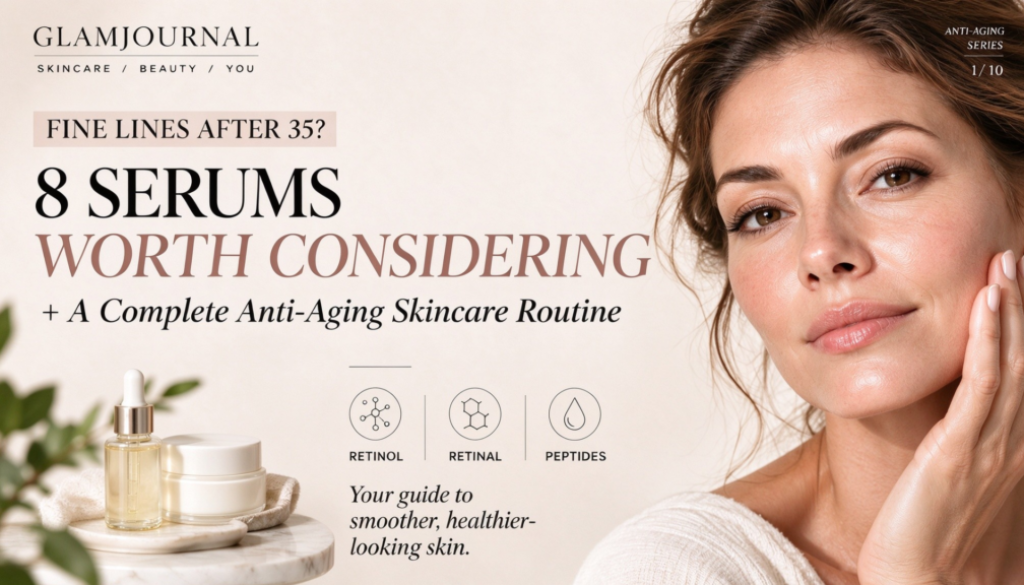
The most useful approach is to understand what may be making your fine lines more visible, choose ingredients that match your needs, and build a consistent routine around them. Retinol and retinal are popular options for addressing visible signs of aging, while peptides and hydrating ingredients can complement your routine in different ways. Daily sunscreen is essential, too. Source: Allure’s retinol serum guide
In this guide, we’ll explain how to approach fine lines after 35, walk through a practical morning and evening routine, and explore eight serums worth considering for different skin types, budgets, and experience levels.
Affiliate disclosure: This article may contain affiliate links. If you purchase through these links, GlamJournal may earn a commission at no additional cost to you. Product availability and formulations may change, so check the current product label before purchasing.

Why Do Fine Lines Become More Noticeable After 35?
Fine lines don’t appear for just one reason. Understanding what’s behind them can help you choose a more effective skincare routine.
1. Natural changes in collagen and skin elasticity
As skin ages, its collagen and elastin structure gradually changes. Skin may begin to look less firm, and expression lines can become more noticeable over time.
This is a normal part of aging. Skincare cannot stop the process, but selected ingredients may help improve the appearance of fine lines and uneven texture.
2. Sun exposure over time
Ultraviolet (UV) exposure contributes to visible skin aging, including wrinkles, uneven pigmentation, and loss of firmness.
That’s why sunscreen is not an optional finishing touch in an anti-aging routine. A good serum can support your skincare goals, but it cannot replace daily sun protection.
3. Dehydration and a weakened skin barrier
If your skin feels tight, looks flaky, or develops tiny lines that become more obvious throughout the day, dryness may be contributing to the problem.
Hydrating ingredients such as hyaluronic acid and glycerin help attract and retain moisture, while moisturizers containing ceramides can help support the skin barrier. Better hydration can make skin look temporarily plumper and fine lines less noticeable.
4. Repeated facial expressions
The skin around the eyes and forehead moves whenever you smile, squint, or raise your eyebrows. Over time, expression lines may remain visible even when your face is at rest.
Different concerns need different approaches. Hydration may help soften the look of dehydration lines, while retinoids are commonly used to address broader signs of photoaging and fine lines.
The Best Ingredients for Fine Lines Over 35
Before choosing a product, understand what each ingredient can—and cannot—do.
| Ingredient | What it helps with | Best place in your routine |
|---|---|---|
| Retinol | Helps improve the appearance of fine lines and uneven texture over time | Evening |
| Retinal (retinaldehyde) | Another vitamin A derivative used to target visible signs of aging | Evening |
| Peptides | Support a routine focused on smoother, firmer-looking skin | Morning or evening, depending on formula |
| Hyaluronic acid | Hydrates and temporarily plumps the look of dehydration lines | Morning or evening |
| Ceramides | Help support the skin barrier and reduce moisture loss | Moisturizer or hydrating formula |
| Broad-spectrum SPF 30+ | Helps protect against UV damage that contributes to visible aging | Every morning |
Retinol vs. retinal: Which should you choose?
Both are vitamin A derivatives. Retinol is a common starting point for people new to retinoids, while retinal is often chosen by people looking for a different or more advanced over-the-counter retinoid option. Neither is automatically the best choice for everyone, and both can irritate skin. Start with your skin’s tolerance rather than choosing a product based on strength alone. Source: Vogue’s retinoid guide
What about peptides?
Peptide serums can be a useful option if you want to focus on smoother-looking skin without starting with a retinoid. Formulas vary, and results depend on the specific product and consistent use. Peptides are an alternative or complement to a routine—not a guarantee of dramatic wrinkle reduction.
8 Serums Worth Considering for Fine Lines Over 35
These eight options serve different purposes. They are not meant to be used all together. Choose one main treatment and, if needed, one complementary serum based on your skin’s needs.
1. La Roche-Posay Retinol B3 Face Serum
Best for: A retinol-focused evening routine
If your priority is visible fine lines and uneven texture, La Roche-Posay Retinol B3 Face Serum is worth considering. Its formula combines retinol with vitamin B3 (niacinamide) and is designed for anti-aging care.
Why it may be worth considering
- Retinol targets the appearance of fine lines and uneven texture.
- Niacinamide is commonly used to support the skin barrier and improve the look of uneven skin tone.
- A serum format fits easily into a simple evening routine.
How to use it: Apply in the evening according to the label, introduce it gradually, and follow with moisturizer. Avoid combining it with another retinoid in the same routine.
2. The INKEY List Advanced Retinal Serum
Best for: People who want to explore retinal
Retinal, also called retinaldehyde, is another vitamin A derivative used to address visible signs of aging. The INKEY List Advanced Retinal Serum is positioned as a targeted treatment for fine lines and wrinkles.
Why it may be worth considering
- Offers a retinal-based alternative to a traditional retinol serum.
- May appeal to people who already understand retinoids and want to explore another option.
- Can serve as the main evening treatment rather than adding multiple anti-aging actives.
How to use it: Follow the brand’s directions carefully. Because this is a targeted retinal product, it is not the first choice for everyone—particularly those with very reactive skin or no experience with retinoids.
3. The Ordinary Multi-Peptide + Copper Peptides 1% Serum
Best for: A peptide-focused routine
Not everyone wants to begin with a retinoid. A peptide serum is another option for people who want to focus on smoother, firmer-looking skin.
The Ordinary Multi-Peptide + Copper Peptides 1% Serum is designed to target multiple visible signs of aging.
Why it may be worth considering
- Provides a peptide-focused approach to visible skin aging.
- Can fit into a routine built around hydration and barrier support.
- Offers a different treatment category for people who prefer not to start with retinol.
How to use it: Use according to the current product instructions. Check the brand’s compatibility guidance before combining it with other strong active ingredients or direct acids.
4. Cetaphil Healthy Renew Face Serum
Best for: A peptide-focused option for people concerned about retinol irritation
If you want to explore anti-aging care but are concerned about retinoid-related dryness, Cetaphil Healthy Renew Face Serum is another product to consider. Its formula uses purified peptides alongside hydrating and skin-conditioning ingredients.
Why it may be worth considering
- Offers a peptide-based alternative to a retinol-focused routine.
- May appeal to people who prioritize comfort and hydration.
- Can be a practical option for a routine that emphasizes gentle, consistent care.
How to use it: Follow the label and pair it with a moisturizer. If you have sensitive skin, patch-test first; no product is guaranteed to be irritation-free.
5. CeraVe Hydrating Hyaluronic Acid Serum
Best for: Dry skin and dehydration lines
Sometimes the first step is not a stronger anti-aging treatment. If your skin feels tight and fine lines look more pronounced when it is dry, a hydrating serum may be a better starting point.
CeraVe Hydrating Hyaluronic Acid Serum combines hyaluronic acid with ceramides to hydrate skin and support the skin barrier.
Why it may be worth considering
- Hyaluronic acid helps attract and retain moisture.
- Ceramides help support the skin barrier.
- It complements a routine that includes a separate retinoid, provided your skin tolerates the combination.
How to use it: Apply according to the label, then seal in hydration with moisturizer. This is a supporting product, not a substitute for a targeted retinoid if your goal is to address persistent signs of photoaging.
6. The INKEY List Hyaluronic Acid Serum
Best for: Straightforward hydration on a budget
If you want a simple hydration step without investing in a more expensive anti-aging serum, The INKEY List Hyaluronic Acid Serum is another option.
Its main role is to support hydration and make the skin look temporarily plumper, which may help dehydration lines appear less noticeable.
Why it may be worth considering
- Focuses on hydration rather than adding another strong active ingredient.
- Can fit into morning or evening routines.
- Works as a complementary step alongside moisturizer and daily sunscreen.
How to use it: Follow the product instructions and apply moisturizer afterward. If you already own a hydrating serum that works well, there is no need to buy another one just to complete this routine.
7. Murad Retinol Youth Renewal Eye Serum
Best for: People targeting visible eye-area lines
The skin around the eyes is delicate, and a product formulated specifically for this area may be easier to incorporate than using a face treatment near the eyes.
Murad Retinol Youth Renewal Eye Serum is designed to improve the appearance of eye-area wrinkles and firmness.
Why it may be worth considering
- Specifically targets the appearance of lines around the eyes.
- Provides an eye-area option for people who want a dedicated product.
- Can be considered instead of using a separate facial retinoid near the eyes, depending on your needs and the product directions.
How to use it: Follow the label and avoid getting the product into your eyes. If you already use a facial retinoid, consider whether a separate retinol eye product is necessary; more products do not automatically mean better results.
8. COSRX The 6 Peptide Skin Booster Serum
Best for: A lightweight first step in a peptide routine
COSRX The 6 Peptide Skin Booster Serum is a lightweight, multi-peptide formula designed to support overall skin appearance. It may suit someone who wants a flexible product that layers with other skincare.
Why it may be worth considering
- Offers a peptide-focused option for daily skincare.
- Can be considered by people who prefer to begin with a non-retinoid product.
- Fits a routine that emphasizes hydration, moisturizer, and sun protection.
How to use it: Follow the product’s layering instructions. You do not need to pair it with several other peptide serums; choose one that fits your budget and routine.
Your Complete Anti-Aging Skincare Routine for Fine Lines
The most important part of this routine is consistency. Start with the basics, then add one targeted serum at a time.
Morning routine: Hydrate, moisturize, protect
Step 1: Cleanse gently
Use a gentle cleanser that removes overnight oil without leaving your skin feeling tight. If your skin is dry or sensitive, avoid harsh cleansing and excessive scrubbing.
Step 2: Apply a hydrating or peptide serum
Choose one serum that matches your needs. Hyaluronic acid is a practical option for dehydration, while a peptide serum may suit someone who wants a general anti-aging product without beginning with a retinoid.
Apply according to the product directions. If you use a hydrating serum, slightly damp skin may help it spread comfortably; follow the label if it specifies otherwise.
Step 3: Apply moisturizer
A moisturizer helps reduce water loss and supports the skin barrier. Look for ingredients such as glycerin, ceramides, and other well-tolerated emollients.
Do not skip this step just because you use a serum. Hydration and barrier support can make a meaningful difference to how comfortable and smooth your skin looks.
Step 4: Finish with broad-spectrum SPF 30 or higher
Apply sunscreen generously to exposed skin every morning. Reapply as directed, especially after swimming, sweating, or spending extended time outdoors.
If you only make one long-term habit non-negotiable for visible skin aging, make it daily sun protection.
Evening routine: Treat, then support the skin barrier
Step 1: Remove sunscreen and makeup
Cleanse thoroughly but gently. If you wear long-wearing makeup or water-resistant sunscreen, use a suitable first cleanse followed by a gentle cleanser if needed.
Step 2: Apply one targeted treatment
If your main goal is improving visible fine lines, a retinol or retinal product may be worth considering. If your skin is sensitive or you are not ready for a retinoid, begin with a peptide or hydrating serum instead.
Do not start several new active ingredients at once. Introducing one product at a time makes it easier to identify irritation and decide whether the product suits your skin.
Step 3: Moisturize
Finish with a moisturizer suited to your skin type. If you experience dryness while introducing a retinoid, use a richer moisturizer or apply moisturizer before and after the treatment, provided the product instructions allow it.
Step 4: Adjust the frequency to your tolerance
Start retinol or retinal on a small number of evenings each week, then increase gradually only if your skin tolerates it. Mild dryness or irritation can occur, but persistent burning, significant redness, or peeling is a reason to stop and reassess your routine.
You do not need to use retinol and retinal together. Choose one retinoid rather than stacking both in the same routine.
How to Choose the Right Serum for Your Skin
You do not need every product in this guide. Use your main concern to narrow the list.
- If your skin is dry and fine lines look more obvious by midday: Start with a hydrating serum such as CeraVe Hydrating Hyaluronic Acid Serum, plus a moisturizer.
- If your main concern is visible fine lines and uneven texture: Consider one retinol or retinal product and introduce it gradually.
- If you want a non-retinoid option: Consider a peptide serum such as The Ordinary Multi-Peptide + Copper Peptides 1% Serum or Cetaphil Healthy Renew Face Serum.
- If your eye area is your main concern: Consider a dedicated eye product, but avoid layering multiple retinoid products around the same area.
- If your skin is sensitive: Prioritize a gentle cleanser, moisturizer, and sunscreen first. Introduce targeted treatments only when your skin is comfortable and stable.
The best routine is not the one with the most products. It is the one you can use consistently without irritating your skin.
How Long Does It Take to See Results?
Hydration can make skin look plumper relatively quickly, but that effect is different from longer-term changes in the appearance of fine lines.
For retinol, retinal, and peptide products, results depend on the formulation, frequency of use, skin tolerance, and the concern being treated. Give a well-tolerated routine time to work rather than switching products every few days. Visible changes in fine lines generally require consistent use over weeks to months, and results will vary.
Take progress photos in similar lighting if you want to compare changes more objectively. Avoid judging a product only by how your skin looks immediately after application.
If you experience persistent irritation, stop using the product and seek advice from a qualified healthcare professional or dermatologist.
Common Anti-Aging Skincare Mistakes to Avoid
1. Starting too many active ingredients at once
Adding retinol, retinal, exfoliating acids, and several new serums together makes irritation more likely and makes it difficult to identify the cause. Start with one targeted treatment.
2. Skipping moisturizer
A treatment serum does not automatically replace moisturizer. Keeping the skin comfortable and supporting its barrier are important parts of a sustainable routine.
3. Treating sunscreen as optional
Even a well-designed anti-aging routine is incomplete without sun protection. Use broad-spectrum SPF 30 or higher every morning and reapply as directed.
4. Expecting a serum to erase deep wrinkles
Skincare can improve the appearance of fine lines, texture, and dryness, but it cannot guarantee the removal of deep-set wrinkles or replicate professional procedures.
5. Assuming stronger always means better
A product that causes ongoing irritation is not necessarily more effective for your skin. The right treatment is one you can tolerate and use consistently.
Important safety note: Retinoids can cause irritation and are generally avoided during pregnancy. If you are pregnant, trying to conceive, or unsure whether a retinoid is appropriate for you, consult your healthcare professional and choose a suitable alternative.
Frequently Asked Questions
What is the best serum for fine lines over 35?
There is no single best serum for everyone. Retinol or retinal may be worth considering for visible fine lines and uneven texture, while hyaluronic acid can help with dehydration lines and peptides offer another approach to anti-aging care. Choose based on your skin’s needs and tolerance.
Should I use retinol or peptides first?
If your main goal is to address visible signs of photoaging and your skin tolerates retinoids, you may choose to start with a low-strength retinol product. If you prefer a non-retinoid option or are concerned about irritation, a peptide serum is another place to begin. You do not need to use both immediately.
Can I use retinol and hyaluronic acid together?
Many people can incorporate a hydrating serum into a retinoid routine. Hyaluronic acid focuses on hydration, while retinol targets visible signs of aging. Use each according to its directions and follow with moisturizer. If irritation develops, simplify the routine.
Can I use retinol and retinal together?
For most at-home routines, there is no need to use both in the same routine. They are both vitamin A derivatives, and combining them can increase the risk of irritation without guaranteeing better results. Choose one and build tolerance gradually.
Is a separate eye serum necessary?
Not always. Some people prefer a dedicated eye product, while others keep their routine simple and use a moisturizer suitable for the eye area. If you choose an eye-area retinoid, follow the product directions carefully and avoid getting it into your eyes.
What is the most important anti-aging skincare step after 35?
Daily broad-spectrum sunscreen is one of the most important steps for reducing ongoing UV damage that contributes to visible skin aging. Pair it with a gentle cleanser, moisturizer, and a targeted serum that matches your needs.
Final Thoughts: A Smarter Fine-Line Routine After 35
Fine lines are a normal part of skin aging, but your routine can help address the factors that make them more noticeable.
Start with the essentials: gentle cleansing, moisturizer, and daily sunscreen. If you want to target visible fine lines, choose one retinol or retinal product and introduce it gradually. If dryness is the bigger issue, prioritize hydration. If you prefer a non-retinoid approach, consider a peptide serum.
You do not need all eight serums. Choose the one that fits your skin, your budget, and your current routine—and give it time.
At GlamJournal, our goal is to make skincare feel less complicated: understand the concern, choose the right ingredients, and build a routine you can realistically maintain.